Skip to content


How to Make a Ring Pin Keeper (Finger or Thumb Pincushion)
If you do any kind of hand sewing (EPP, needleturn applique, hand quilting, binding, even a bit of “where did I put that pin?”), A Ring Pin Keeper (also called a finger or thumb pin cushion or pincushion ring) is one of those tiny tools that ends up being weirdly life-changing. It sits on your finger or thumb, keeps a few pins right where you need them, and stops you from doing the classic move of parking pins in your sleeve, shirt, your pants, or (ouch) your own finger.
This is not a design I invented. It’s a classic little pincushion shape that’s been floating around the sewing world for years. Below is my Craftapalooza version of a Ring Pin Keeper, including how I like to hand-sew it, my preferred interfacing option, and an optional wrapped-fabric band finish for the join.
What Is a Ring Pin Keeper?
A Ring Pin Keeper is a tiny wearable pincushion you pop on your finger or thumb while you sew. It keeps a few pins within easy reach, making it especially handy for hand-sewing projects like EPP, applique, hand piecing, and binding.
What you’ll use:
- 1 fabric square (see sizing below)
- Fiberfill/polyfill
- Milliner #10 needle (or similar for hand sewing)
- Matching thread
- Fabric scissors
- Fabric marker
- Small quilt ruler
- Cutting mat and rotary cutter (optional)
- Optional: lightweight non-woven fusible interfacing
- Optional: chopstick/awl/point turner (for corners)
About fabric
Small-scale prints or ditsy florals look amazing for this project, especially if you’re using treasured scraps.
Fabric Size Guide for Finger and Thumb Pincushions
These all work. The overlap step is where you customise the final fit.
- 3 " (7.5 cm) for smaller fingers
- 3½ " (9 cm) for most fingers
- 4½" inch (11.5 cm) for larger fingers
My personal preference: I use a 4 " square. It works best for my finger size.
You can wear this as a finger pin cushion or a thumb pincushion, depending on your preferred fit and how snug you like it.

Before you start
- Press the fabric.
- Cut 1 fabric square
You may need to make a couple in different sizes to find your “Goldilocks” fit. The good news: they use tiny scraps, come together quickly, and are easy to batch-sew.
Optional: fuse lightweight non-woven interfacing to the back of your fabric, then cut the square. I like interfacing for these, especially with Liberty Tana Lawn.
Mark your stitching lines (hand sewing)
I hand-sew these, so I mark ¼" stitching lines. If you’re machine-sewing, use your ¼" foot as your guide. Fig. 1.
Mark the turning gap
On one stitched side, start at a point and place a mark 1" up along the seam allowance. From that mark, measure another 1¼" and mark again. The space between these marks is your turning gap. Fig. 2.
Fold
Fold diagonally, right sides together, to form a triangle. Fig. 3. Pop a pin through the centre to hold the fold in place. Fig. 4.
Stitch
Stitch the two raw edges, leaving the turning gap open where you marked it. Fig. 5.
Hand stitch (running backstitch): Take two small running stitches, then take one backstitch. Repeat along the seam. Start and finish with a couple of backstitches to secure. Fig. 5.
Machine stitch: Use a short stitch length and backstitch at the start and end. Leave the turning gap open.
Finishing
Clip corners and turn.
Clip the corners carefully (don’t cut your stitches). Fig. 6. Turn right side out and gently push out the corners. Fig. 7.

Stuff
Stuff firmly in the centre, but leave the pointy ends softer (or lightly filled) so they can overlap to form the ring.
Close the turning gap
Close the turning gap with a ladder stitch.
Form the ring and secure
Wrap it around your finger and overlap the ends until it fits comfortably.
More overlap = smaller ring
Less overlap = bigger ring
A note about fit and angle
I prefer to wrap the ends towards the back of the ring so it sits on my finger at a flatter angle. Figs. 10-11.
If you wrap and fold the ends under the ring, it will sit more upright. Figs. 8-9.
This is personal preference, so try both and see what feels best.
Stitch the overlapped ends together securely.

Optional wrapped fabric band join finish
I like to wrap the join with a small fabric band for extra strength and a neat finish.
How to cut the band
When you cut your square, add an extra 1 inch to the width. From that extra fabric, cut a strip ¾" wide and about 3-4 inches long.
Prep the band
- If there’s interfacing on the strip, peel it off.
- On the wrong side, mark a ¼" line along one long edge. Fold on that line and press Fig. 12.
- Fold the other long edge over so it overlaps the first fold (it will be a smaller fold than ¼" inch). Press flat Figs. 13-15.
- Wrap and stitch
Wrap the band slightly diagonally around the join 2-3 times, overlapping.
Trim the excess, leaving about ½". Fold the raw end under to hide it, then tack stitch along the folded edges to secure.
For extra hold, take the needle through the centre of the join to the other side, add a small tack stitch, and repeat once more if needed. Knot off, trim your thread, and you’re done.
How to wear and use your Pin Keeper
Pop this little hand sewing pin cushion on your pointer finger or thumb, park a few pins in it, and keep stitching.
Once you use one, it’s hard to go back.
Tips for the Best Fit
- More overlap = smaller ring
- Less overlap = bigger ring
- Wrap the ends towards the back for a flatter fit.
- Wrap/fold the ends under for a more upright fit.
- Make 2-3 in different sizes to find your favourite fit.
Share Your Pin Keeper
If you make one, I’d love to see it. Tag me on Instagram @craftapalooza and use #NicsFingerPinnie so I can find your post.
Read more...
-
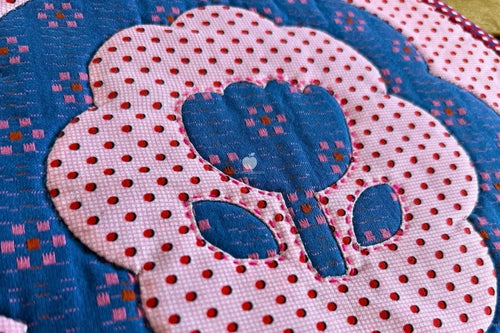
Cameo Bloom: A Petite Masterclass in Reverse Needle-Turn Appliqué
Cameo Bloom is a little jewel of a project - a technique-packed mini quilt that lets you explore the art of reverse needle-turn appliqué without co...
-

Free Sunshiny Days Quilt Block
It's April and that means Quilt Block Mania has a new block. This month's theme is beach. The sun was an obvious choice right?! And reverse appliqu...
-
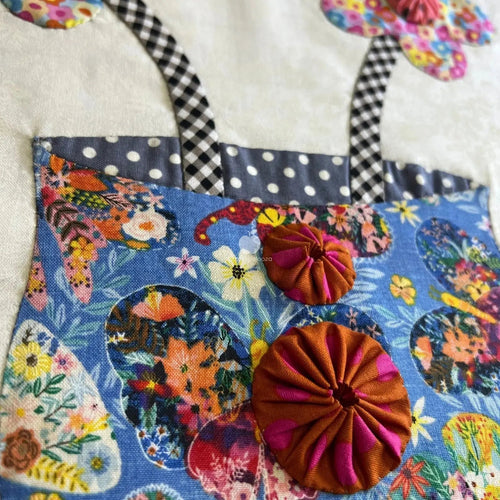
Free Tea for Me Quilt Block
Hooray for the March Quilt Block Mania I'm excited to share this Tea for Me quilt block with you. I have needleturn appliqued the block as pictured...